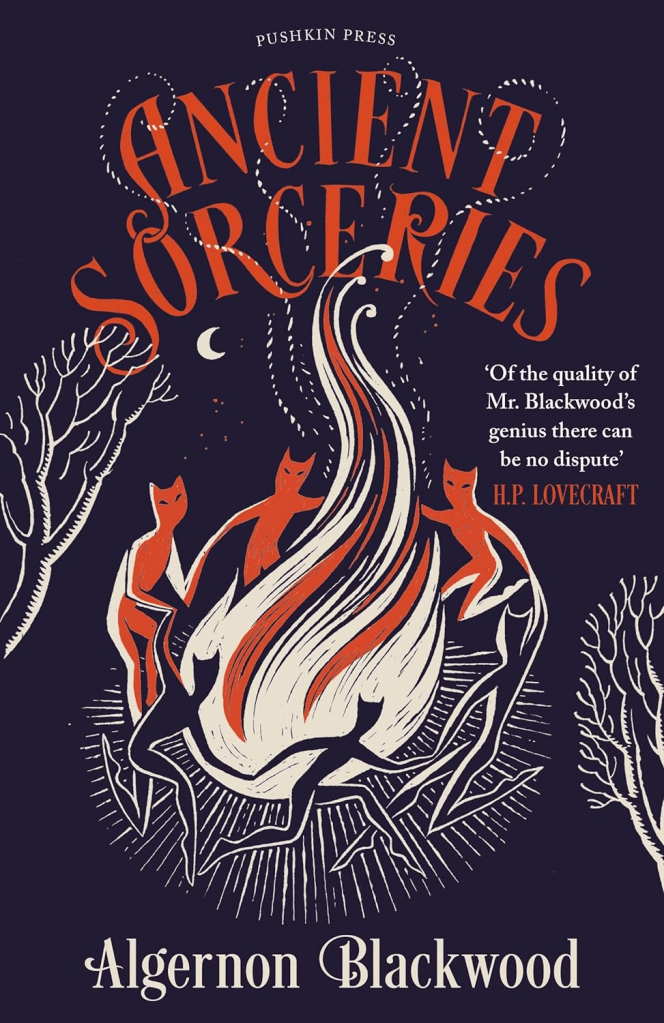
Review of Ancient Sorceries (and other Short Stories) by Algernon Blackwood

Synopsis:

A beautifully produced new edition of Blackwood’s weirdest supernatural stories, including “The Willows,” highlighted by H.P. Lovecraft as “the single finest weird tale in literature”

Lauded as one of our greatest storytellers, and inspiring generations of writers from H.P. Lovecraft to Tolkien to Stephen King, Algernon Blackwood left a legacy as one of Britain’s greatest conjurors of weird and supernatural stories. Blackwood’s inimitable style puts readers right in the middle of the story, with visceral and nature-inspired fear that lies just beyond the real, often in the form of a nameless dread.

This beautifully produced edition, with a stunning cover and thoughtful design and layout to ensure the most enjoyable reading experience, features four of his most unnervingly curious tales:

  • Ancient Sorceriesa traveller stops in a remote French hill town and soon finds himself unable to leave; there is something strangely feline about the inhabitants, he notices, and they all seem to be watching him very closely…
  • The Listenera lodging house guest feels himself observed by a malevolent presence. Soon it transpires his room’s previous occupant is watching him from beyond the grave, and is envious of the very flesh on his bones.
  • The Sea Fitan old retired ship’s captain’s ravings build to a terrifying climax, as he offers himself up as a sacrifice to the cruel gods of the sea.
  • The Willowstwo friends on a canoeing trip spend a terrifying night on a lonely willow-covered island, haunted by the strange trees and sinister shapes in the water.

Review:
Ancient Sorceries
I definitely liked this story and the constant reminder that peculiar things don’t often happen to regular people that do what is expected from life. I also like the aspect of timing and how sometimes time slips away from us, and how feelings can cause all sorts of interesting stories in our minds.

The Listener
This was by far my absolute favourite of the four stories in this anthology. I thought it was properly spooky with an amazing set up and you’re left wondering so many times between issues of insomnia, bad sleep, some sort of mental illness that requires medicine, and just so many things that it could be, and no idea what exactly is going on. At the end I was merely stunned. Absolutely adored it.

The Sea Fit
This was quite an interesting story as well, my second favourite in the anthology. It was clear that there was something a bit off about the retired ship captain, but why, exactly, were the others invited?

The Willows
This one was a longer one, and I very much felt that it somewhat dragged. I wasn’t drawn into the world the way I was with The Listener and The Sea Fit. I wanted so badly to love this as it was allegedly one of Lovecraft’s favourites of Blackwood, but while there were parts of pure uncertainty, there was a lot of paranoia and occult/supernatural versus natural phenomenon. The very end left me a bit befuddled, and I’m still uncertain how I feel about it.

All in all I quite liked this book of Algernon Blackwood and intend to add more books of his works to my collection in the future. I did buy the hardcover of this when traveling, however, it’s quite cheap if you’re looking for an e-book spooky story to read.

Star rating: ✯✯✯✯

Review of A Little Princess; being the whole story of Sara Crewe by Frances Hodgson Burnett

Star Rating: 
Genre: Young People, Young Adult
Number of Pages: 2649781435142091_p0_v4_s260x420

Season Read: Fall

Synopsis:(From Amazon)
At Miss Minchin’s Select Seminary for Young Ladies, young Sara Crewe enjoys the friendship of her classmates and the staff–much to stern Miss Minchin’s disdain. When Sara is unexpectedly impoverished, she is forced to become a servant under Miss Minchin’s control. To escape her dreary life, Sara imagines herself a princess, and her experiences soon teach her that being a princess on the inside counts more than any outward expression of royalty.

Review:
I love this novel so much.  What’s wrong with being a princess?  Being a princess is hard work.  You have to remain poise and collected no matter what adversity strikes you.  You have to do what is good for all above what is good for yourself.  You must also be kind.  Are those not the attributes many like to see in not just women, but all people in society?  There is a great deal of difference between “princess” and “damsel in distress.”  Sara is an amazing character who, despite everything horrible going on around her, tries to remain strong and trustworthy for those who rely on her.And I still love the 1997 movie just as much, although there are some significant changes to what happens.  Most of the changes between the book and movie adaptation could have been done to make it easier to understand the complete story for a new generation, and to tell the story without having a three hour movie.

500px-Frances_BurnettAuthor Bio: (From Wikipedia)
Frances Eliza Hodgson Burnett (24 November 1849 – 29 October 1924) was an American-English writer of plays and prose fiction. She is best known for the three children’s novels Little Lord Fauntleroy (published in 1885–1886), A Little Princess (1905), and The Secret Garden (1911).

For more information, check out Frances Hodgson Burnett’s Wikipedia page.


If you like this review, and the writing style of this quirky reviewer, please consider visiting and liking my Facebook author page: Lizzy March.

Thank you!


Review of Little Women by Louisa May Alcott

Little Women
By Louisa May Alcott

Star Rating: 33ca69cabaa0cbc84d3d2435e6201f63
Genre: Fiction/Classical
Number of Pages: 280

Season Read: Fall

Synopsis:(From Amazon)
Following the lives of four sisters on a journey out of adolescence, Louisa May Alcott’s Little Women explores the difficulties associated with gender roles in a Post-Civil War America.

Review:
When I was younger I read the Great Illustrated Classics version of this novel, and I loved it.  The kindle version of this novel is free, so I would greatly recommend a purchase, though I do have a leather bound edition from Barnes and Noble.  This novel has a great way of showcasing many difficulties that people have while growing up, and I love that it is often the girls’ mother who teaches them lessons about their behaviour.  Although there are some sad parts, I do believe everyone has to deal with separations and trials in life, and it is better to be prepared.  While I did not particularly like the shift between the first half and the second half of the novel, in which Alcott breaks the fourth wall and speaks directly to the audience, I can understand why she did.  Like Jo, Alcott is not capable of keeping her opinions on her writing to herself.

I would also add that while there are a lot of various renditions of Little Women in film my absolute favourite is the 1933 edition with Katharine Hepburn, which you can find here.  I will likely write a review of the movie and how close it is to the book in the near future.  I absolutely adore the movie, so much so that I purchased the DVD (because my VCR ate a VHS, so my VHS version of this movie is no longer watchable).

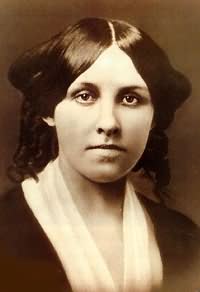
Louisa_May_Alcott_headshotAuthor Bio: (From Wikipedia)
Louisa May Alcott (/ˈɔːlkət, kɒt/; November 29, 1832 – March 6, 1888) was an American novelistand poet best known as the author of the novel Little Women (1868) and its sequels Little Men (1871) and Jo’s Boys (1886).[1] Raised by her transcendentalist parents, Abigail May and Amos Bronson Alcott in New England, she grew up among many of the well-known intellectuals of the day such asRalph Waldo Emerson, Nathaniel Hawthorne, and Henry David Thoreau.

For a more detailed biography of Lousia May Alcott, please visit her wikipedia page, but if writing a paper, don’t use Wikipedia as a source.


If you like this review, and the writing style of this quirky reviewer, please consider visiting and liking my Facebook author page: Lizzy March.

Thank you!